Import & Export
Move data in and out of the app: add your holdings from any statement or spreadsheet, backfill your net-worth history, download or restore a full backup, or load a sample portfolio. It lives under Settings → Import & Export.
How to use
- Open Settings → Import & Export.
- Pick what you want to do from the tabs at the top:
- Holdings: add your positions (quantities and amounts) from a broker statement, export, or spreadsheet.
- Net worth history: backfill your daily net-worth figures over time.
- Backup: download a full backup, restore one, or delete all data.
- Sample data: load a demo portfolio to explore the app.
- Fill in the fields for that tab and submit.
For a CSV, paste your rows into the CSV content box, or use the load a .csv file link above it. A live line under the form shows how many rows parsed (or the first problem found) before anything is saved. Set Mode to Add to existing to keep what's already there, or Replace to clear that data first (you'll be asked to confirm).
Good to know
- Got a statement or spreadsheet in the wrong shape? The Holdings and Net worth history tabs each have a Copy prompt button. Paste the prompt into ChatGPT or Claude along with your statement, export, or spreadsheet, and it returns a CSV in the right format to paste back in.
- Holdings import isn't your transaction history. Each imported row becomes a holdings snapshot (the position's starting point) not buys and sells, so nothing shows up in the History tab. Use Trade or a backup restore if you want full history.
- The Holdings snapshots table below the form lists every snapshot row. Each row's menu (⋮) has "See past transactions". It jumps to the History tab filtered to that position, the quickest way to chase a cost-basis question. Clicking the row's quantity shows how the number was built, event by event.
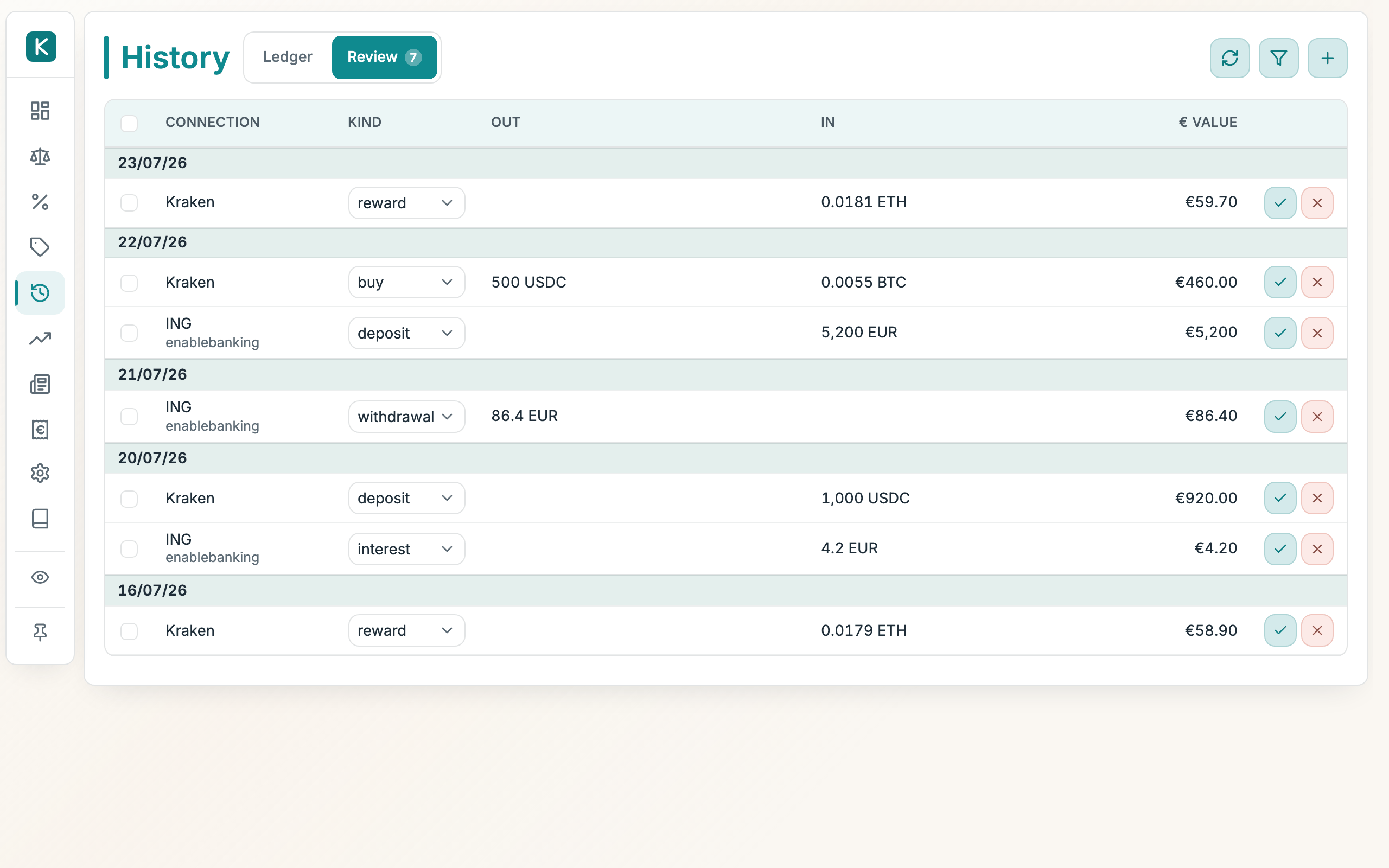
- To pull real transactions from a connected exchange, wallet, or fund (Kraken, Coinbase, OKX, Zerion, Spiko), you don't use this page. Set that connection to transactions mode under Settings → Sources. Its events land in the History → Review queue for you to keep or dismiss before they post.
- Swapped into a token you don't track yet? The trade still lands in Review, with the unknown side showing a "Link to holding…" box. Link it to an existing holding or create the position right there. The link sticks, so future events on that token resolve on their own. Pick skip instead to keep only the side you track. When no tracked side remains (say, a fee on a token you don't hold), skip dismisses the row. Worthless airdrop spam is filtered out before it reaches the queue.
- Restoring a backup replaces everything, but a copy of your old data is saved first. In the desktop app that copy stays on your computer, a dated file next to your database. On the hosted app, contact support to put it back.
- Replace mode clears that tab's data before importing: every holdings snapshot, or your entire net-worth history. Make sure that's what you want.
- Sample data wipes everything you have, so only load it on a fresh or throwaway setup. There's an Investor Portfolio and a simpler Family Overview to choose from.
- A header row in your CSV is optional. If you include one, it must contain all the expected columns, but they can be in any order; without a header, the values are read in the order shown in the box.
- Delete all data is permanent, and it clears your settings too, including your stored API keys and custom lists: you come back to a brand-new install. It lives in the Backup tab, under Danger zone, right next to the backup button on purpose. Always download a backup first. A backup you restore later brings the settings and keys back with it.